
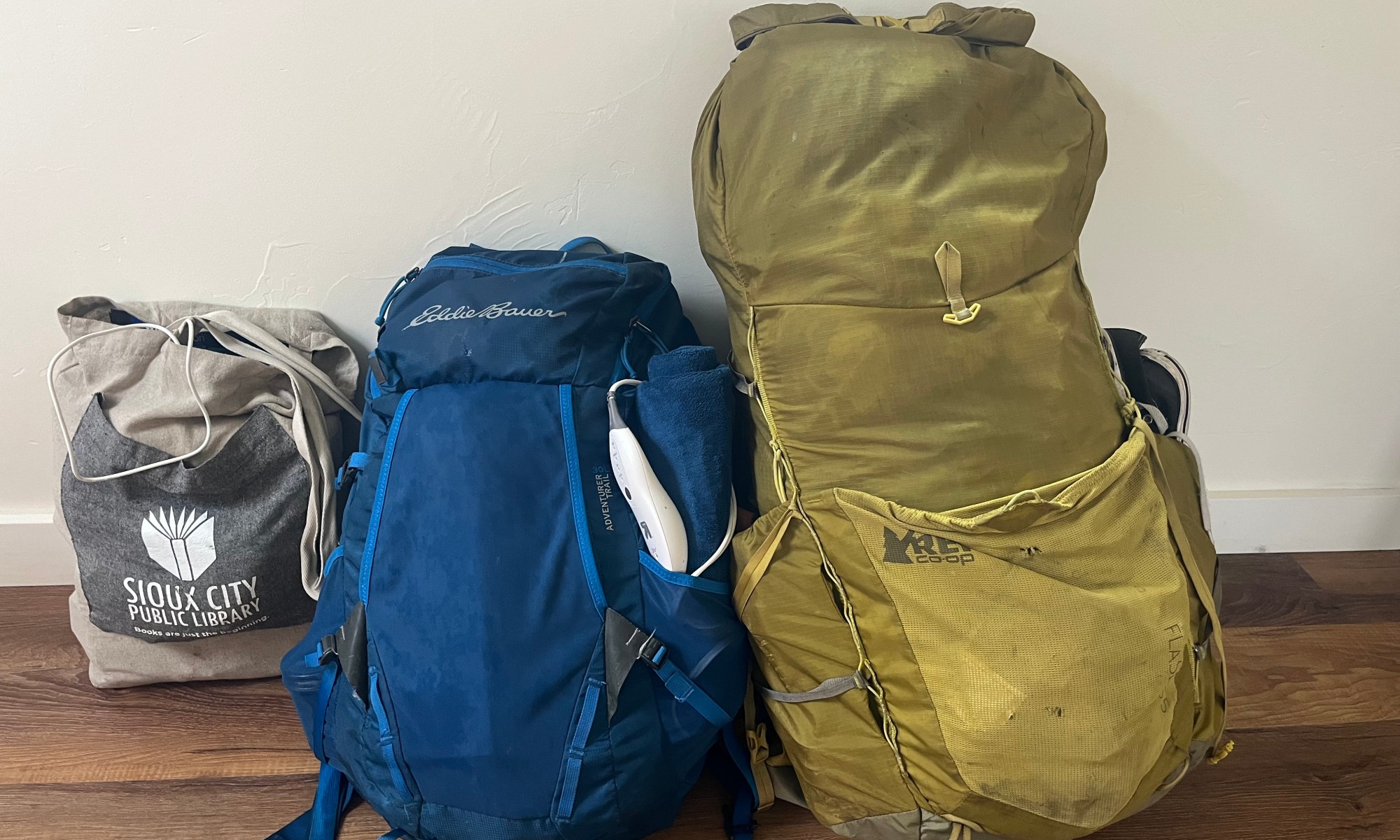
In this last year, I lived in ten different cities and towns. I lived in four different timezones, who knows how many different landscapes: desert, mountains, plains, coast.
One week, I went from a tank top in Oakland winter to -7 in Nebraska City. This last month, I experienced the first snowfall in Monson, Maine and then suddenly landed in tropical humidity in Xalapa, Mexico.
I know this isn’t normal, to shift my body so abruptly from one place to another, never fully experiencing one season at a time. I don’t actually believe the human body should feel such jarring changes like this. Ever since I read William Gibson write that “jet lag” is actually “soul delay,” I never stopped thinking about it. Every time I travel, it feels like my sould hasn’t quite caught up with where my body landed, like it still needs a few extra days to fully arrive in a new place. So many writers have reflected on how there was something more humane about the slower forms of travel from the past – wagons, trains, walking—that allowed our body to move gradually, with incremental shifts that gave our minds and souls time to catch up.
All this traveling happened after I got accepted into five residencies, spaced out over the year in a way that required cobbling together sublets, house and pet-sitting gigs, and crashing with friends in between – a chaotic schedule of living mostly out of a backpack, and moving nearly every month.
When I was a little girl, I know I dreamed of this: of being the kind of “serious” writer who others offer cabins in gorgeous woodsy places, and food and space and time, with no responsibility or instruction at all except to Work On My Art. The reality turned out to be both exactly as romantic, and totally not as romantic, as my younger self would have imagined.
There is something undoubtedly romantic about the spaciousness of residencies: to read a book one morning by the fireplace, and fall in love with it so much that I just keep reading through lunch. To stare out into the woods outside my window, with a cup of dark roast coffee, and let myself journal for fifteen pages just because the mood strikes. To take walks through dreamy New England foliage, even on a drought year that all the locals claimed was far less bright than usual, but to us out-of-towners still felt like magic. So many days, I found myself waking up so happy, and then realized how rare that feeling was, to wake up so consistently excited for all the things I would do in a day.
That kind of spaciousness – paired with being constantly in the company of other artists – took my brain to wildly beautiful creative places: giant epiphanies, ridiculous research spirals, over four hundred pages of writing. Out of nowhere, I started recording myself singing songs I love in Spanish (I’ve recorded sixteen so far). The spontaneity of this new hobby makes me wonder what other forms of creative expression would emerge out of me if given the kind of space I had this year. Some days it felt like my mind was almost in a kind of “artist subspace” – a unique kind of consciousness it had never experienced before. “Residency brain,” I started calling it. The mental state of a brain gravitating always towards creation, and more easily filtering out anything that distracts from that. I am so grateful my brain sometimes could accomplish it, this brief full immersion into a creative universe, and allowed itself to feel the euphoria of that.
But of course, I learned quickly that even in the safe enclosure of a residency, this mental state couldn’t last long. Life always kept sneaking in. A family member’s death. My father’s prostate cancer diagnosis. My co-living situation falling apart and having to put all my things in storage. Friend break-ups. Friend make-ups. Chronic pain flare-ups. Family estrangement stuff (always).
Boundaries definitely helped – leaving social media, disconnecting a bit from my phone altogether (one month I even asked friends only to send texts/vms about creativity, and that actually worked really well?) – but residencies still were never going to provide some “pure” creative state. If anything, they taught me how to integrate art always, in any circumstance I find myself.
There were other less romantic downsides too: sometimes the food sucks, or isn’t what you want to eat. Cabin fever is real when many residencies take place far outside a town, and most residents have no access to a car. The lack of diversity can be hard: I was always the only Latinx person at every residency I went to, and often the only QTPOC.
It’s also true that this year has been one of the most financially precarious of my life. Last August, I left a client – my main source of income — over a disagreement around speaking out for Palestine. And after the inauguration, my diversity, equity, and inclusion work became almost nonexistent. Then, a federal grant I applied for dissolved with funding cuts. The year was a wild mix of peak creative indulgence and extremely frantic job searching.
I gain lots of affirmation from reminders like this from Toi Marie that capture my feelings about what unemployment actually means right now. I know the position I’m in isn’t something to take personally. I know that keeping us in a panicked financial state is how this system is designed. And I know that the feeling I had of waking up happy so many days at residencies: it’s a feeling that comes from experiencing life without financial anxiety, a brief period of time where I had all my basic needs met for me each day, and no need at all to focus on my daily survival. A residency, essentially, is the closest I’ve ever come to experiencing what life could feel like outside of capitalism.
In October, when I heard about D’Angelo’s death, I spent two nights alone, listening to all of his albums chronologically, from his first song to his last. I enjoyed the slowness of this ritual, how in this rapid news cycle we all live in, it offered me space to really acknowledge who was lost. What I admired most about D’Angelo was his slowness, how he never rushed or forced an album when it wasn’t ready. I guess as a 37 year old writer who these days averages around an essay a year, and still has yet to publish a book, I feel grateful for his reminder that art was always meant to be slow, that art is not the same thing as “content”, that “produced” was never the right word for how art is made. What I have learned and felt deeply in this year of residencies, is that the kind of art I love is art that is lived into, the art that emerges from my body, just like those Spanish songs that suddenly came out of me this year. This is how art has actually always felt for me. It never worked as my main source of income. And it never even worked entirely as my sole focus or hobby. It always worked best as a spiritual accompaniment to the waves of my life, as a deep and committed relationship I have walked alongside since I was a kid, as something I always carry with me that sometimes propels my life in wild and beautiful directions.
This year, writing is what made me start traveling again. After six years of settling down in Oakland, it picked me up and put me on the move, and gave me moments where I found the exact thing I didn’t know I needed, in a place I never thought I’d be. In April, I found the most queer and trans salsa dancing space I’ve ever experienced in Boise, Idaho. In May, I finally understood what ancestral belonging feels like by finally visiting Cocula, Mexico. And in October, I experienced the most meaningful Día de Muertos gathering in Monson, Maine.
Moments like these always bring me both elation and FOMO: If I found such perfect alignment in this random place, what other life-changing experiences await in places I haven’t yet traveled to? What do I still not know I’m missing? I think those questions have always been what makes me endure all the very real exhaustion of so much moving around, the long walks across airports hauling too-heavy bags that carry your whole life, the delayed buses, the days of transit without eating a vegetable. I think I do it from the belief that some kind of liberation still awaits for me somewhere else, a sense of belonging and home I haven’t found yet.
When I first began this residency-hopping journey, I was asked to write an essay for an anthology called “Living Together: Reimagining Community In the Age of Disconnection.” I wrote about the complexity of building a sense of home as a queer person of color, about what it takes to feel “grounded” within a constantly unstable and unjust world. I titled the essay “The Myth of Stable Ground.” It feels telling that now, as I end this year, that book is finally being published, because in many ways my essay’s message is what I now need to remember most: in a world of rising fascism and climate chaos, home has to be a fluid thing, a thing we sometimes have to temporarily carry on our back if need be, a thing we will always make and remake, as I did this year and will keep learning to do again.
More Updates and Cool Stuff My Friends Are Doing
- In this year of residencies, I’ve been reading my work a lot! You can watch the reading from Storyknife residents here: https://vimeo.com/1120278678?share=copy
- You can pre-order “Living, Together,” by clicking here
- In August, I did a revised (and way less intense/rigorous) version of the Sealey Challenge where I posted one poem a day on IG about Palestine, in hopes of raising money for my friend Mayar, who is struggling with her family in Gaza. I loved that my morning ritual that month became searching internet archives and anthologies for the right poem of the day, learning the names of so many Palestinian poets in between. So many gave language to feelings I have struggled to find language for. I copied the list of all 30 poems at the bottom of the letter. To donate to help Mayar, visit here.
- Three amazing friends I am privileged to know have their books available for pre-order right now!
Preeti Vangani, who always writes so deeply and beautifully about mothers and ancestry, has a new poetry collection “Fifty Mothers.”
Miriam Pérez’s book with Verónica Bayetti Flores “Muévelo” takes all their brilliant insights from the podcast Radio Menea and transforms it into essays and musings on the history of Latinx music.
And my dear friend M. K. Thekkumkattil’s book “The Sexuality of Care” makes amazing connections between nursing, kink and how we dismantle our current systems of care (I even have a lil cameo in an essay).
- A friend of mine recently had top surgery and is in need of some extra funds to make it through their recovery. If you haven’t given a little something to trans folks this year, this is a great way to show support! Any amount counts.
Palestine Poetry Challenge
- Not Just Passing by Juba Abu Nada
- The Man and his Girlfriend by Dalia Taha
- Separation Wall by Naomi Shihab Nye
- 3aib by Hajer Mirwali
- To my Daughters by Shereen Naser
- This Rubble is Mine by Noor Hindi
- Wife Reversal by Hala Alyan
- Do You See Them by Lisa Suheir Majaj
- Mimesis by Fady Joudah
- Thirst by Noor Hindi
- Do you know what it feels like to be bombed by a F16 by Talah Abu Rahmeh
- I am you by Refaat Alreer
- Enter Poem by Dalia Taha
- Rifqa by Mohammed El Kurd
- Talisman by suheir hammad
- Non lieux by Zeina Azzam
- Last sky world Fargo Nissim Tbakhi
- Silence for Gaza by Mahmoud Darwish:
- Poem of the Time by Yrsa Daley-Ward
- Intifada Incantation by June Jordan
- Untitled by Nasser Rabah
- It No Longer Matters If Anyone Loves Us by Samer Abu Hawwash
- Poem by Danez Smith
- Palestine is Teaching Us Decolonization is Not Abstract by Sarah Borjaz
- Dear Gaza by Hala Alyan
- We teach life sir by Rafeef Ziadeh
- Two Countries by Naomi Shihab Nye
- Of Harvest and Flight by Deena K Shehabi
- Fuck your lecture on craft my people are dying by Noor Hindi
- On the eve of yet another nakba, a dream by George Abraham
Discover more from Amanda E. Machado
Subscribe to get the latest posts sent to your email.
 Amanda E. Machado