
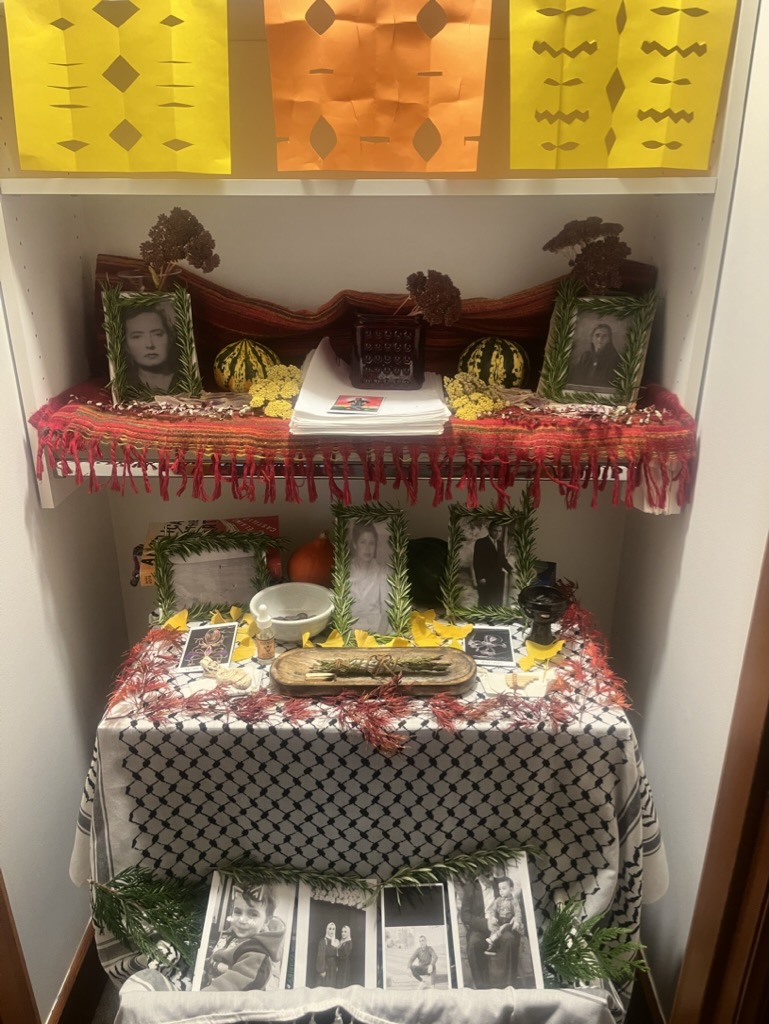
Two days before Día de Muertos, I decided I wanted to build my own ofrenda for the first time. Even growing up in an Mexican family, I had never made one myself before, and so many things about this year made me feel like it was the right time.
I’ve been on Vashon Island for the last two weeks at an artist residency, and so I knew I’d have to make almost everything from scratch. I printed out the few black and white photos of ancestors I had on my computer, got some Elmer’s glue and pasted them against cut-out cardboard from my cereal boxes. Then I picked branches of rosemary from the garden, and glued them on each side of the photo to make frames.
I placed my keffiyeh across a dresser, and used a spare blanket from the living room to drape across a shelf. I picked fallen ginkgo leaves and pine branches, and red leaves from the maple tree in the front yard, and scattered them across the cloth. I made my own version of papel picado by folding and cutting shapes into leftover colored paper from the residency office.
I reached out to my friend Mat — who has led a GoFundMe for Mayar, a woman living in Gaza — and I asked them how we can honor her on the day. Mayar sent photos of four of the nine family members that had been killed this year, along with their stories: her grandfather, her aunt and her children.
I printed out the photos and placed them on their own shelf, draped in more rosemary and pine.
didn’t know if it was “okay” to take basically two days from a residency to create this, when I should have been “working’ on my writing, the many projects I wrote on my application promising to finish. But once I received Mayar’s photos and stories, I realized that not only was this altar perhaps the healthiest way I could channel the intense emotions I’ve had before this election, but it was also the most honest action I could take in response to what is happening in the world: to devote my time to honor ancestors, honor those killed by our state-sponsored genocide, listen to their stories, remember them.
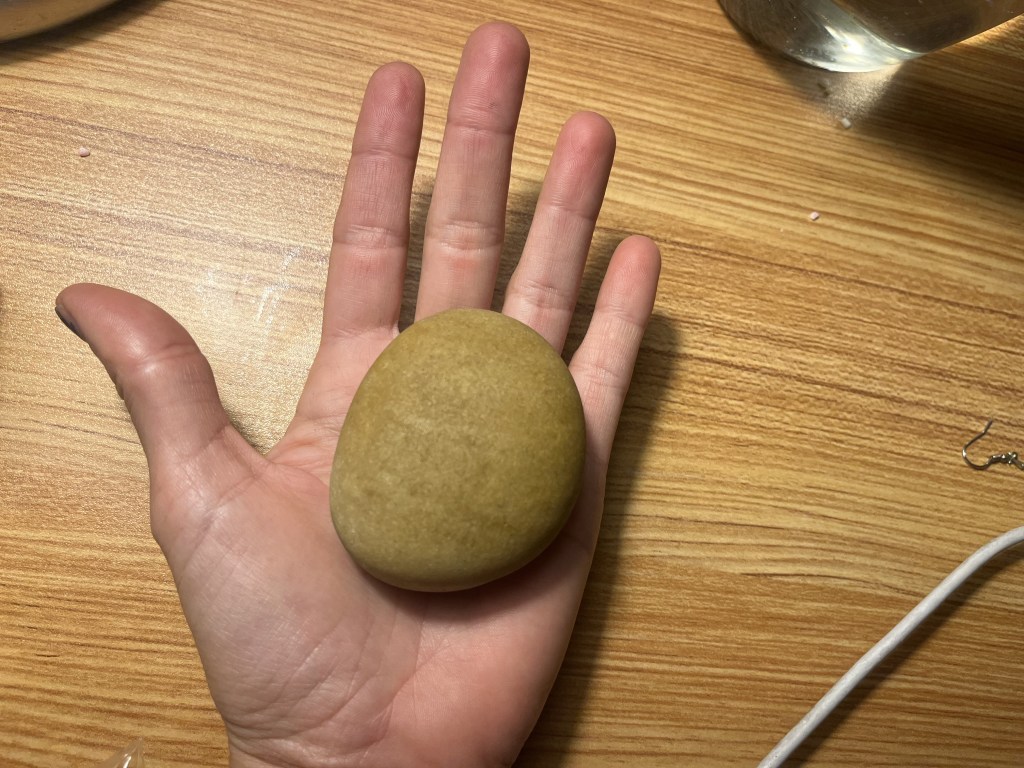
A few weeks ago, the residency here connected us with a geologist on the island. He took us for a walk along the beach, pointing out rocks, and at one point he placed a small, rusty orange one in my hand and said:
“This rock is at least a billion years old.”
He explained how geologists can track rocks like these back to their origin in British Colombia, how they traveled here carried through glaciers, and made there way here on this shore.
I stood there mesmerized that I held something in my hand this mindblowingly ancient, that this rock had witnessed a billion years of life on this planet before it arrived in my hand.
The geologist kept using the phrase “deep time” — a term that geologists use to refer to the different perspective of time necessary to understand the evolutionary processes in their work. Earthquakes, tectonic shifts, the travels of rocks all happen on a timescale of billions upon billions of years, a scale entirely different than the time we track in human life.
Deep time, I realize, is also what I lived in when making my ofrenda. It’s what I live in when I try to talk to ancestors, and heal the many generations I carry in my body. It’s what I live in when I write. And what I love about residencies is that they allow a spaciousness to delve into that kind of deep time, and listen to what it’s trying to say.
Deep Time is what I want to focus on during this election. I know I’m doing the work of my life well if it does not change by what happens today or in the next few weeks, because I am judging my work on a scale so much longer than that. I want to only think and write and do things that will matter in one billion years. I want to leave my lineage as clean and healed as it’s ever been. I want to do everything I can to remember.
Discover more from Amanda E. Machado
Subscribe to get the latest posts sent to your email.
 Amanda E. Machado